


Diogenes In Exile is reader-supported. Keep the lamp of truth burning by becoming a paying subscriber—or toss a few drachmas in the jar with a one-time or recurring donation. Cynics may live in barrels, but websites aren’t free!
Sept 21, 2026, is the deadline to chime in about what could be the most groundbreaking changes in accreditation regulations in decades. In this post, you are going to learn what these changes are, why they matter, and how to write a comment that gets read.
On 20 August 2026, the Office of Postsecondary Education announced its new Accreditation, Innovation, and Modernization: the Secretary’s Recognition of Accrediting Agencies: Institutional Eligibility Under the Higher Education Act of 1965, as Amended, Student Assistance General Provisions. Though the titling is more than a mouthful, as of this writing, 685 comments have already been received, and with these regulations having downstream effects that penetrate everything that touches the education system, there will be more.
If you’re wondering what has everyone so excited, primarily, it is significant deregulation. Here are some highlights:
§ 602.18(b)(4) — Calls for accreditation agencies to ensure that their decisions are neutral to ideology and viewpoints unrelated to their standards. This change addresses accreditation being used to push DEI into higher ed, while retaining a carve-out for accreditors with a religious mission. It’s unclear if that would prevent problems seen in counseling and social work.
§ 602.17(g) — Prohibits accreditors from having standards that break state or federal law, including preferential policies based on race. This would address abuses seen in programmatic accreditors with diversity standards.
§ 602.16(f) — Directs that additional standards beyond the minimum required by law must be consistent with quality and integrity, not illegal in other ways. This would address the overreach seen in the American Bar Association, social work, counseling, and many other profession-specific accreditors.
§ 602.14 — Defines what it means for accreditors to be “separate and independent” from trade associations, professional organizations, and membership groups. It calls for mandatory conflict of interest controls, and the reasons for this are something I’ve documented in counseling.
§ 602.24 / § 600.11 — Calls for accreditation to address general consumer protection measures, like plans for students to finish in progress degrees if a program shuts down, likewise for transcript access if a college goes under. It would also require that students be able to transfer credits more easily if they change schools.
To be clear, while these provisions have not been adopted yet, these measures were agreed to by negotiators representing students, veterans, institutions, accreditors, and others. This consensus is largely binding, and at this stage, only a monumental lift would see any of them struck down; nevertheless, this is your opportunity to make your feelings known.
Where comments have the most influence are in the areas where the Department of Education (ED) has specifically asked for help, like in the Regulatory Impact Analysis (RIA).
The ED states outright that data on the impact of these new regulations is limited. Part of the purpose of this comment period is to poll for feedback on methods, data sources, and any prior research on accreditation reform, specifically regarding innovation, competition, and quality, and the effects on student behavior and outcomes.
Comments on unidentified impacts, especially with supporting data, are sought after, as is input on the Paperwork Reduction Act, intended to limit the burdens of implementation.
Information on reducing costs and increasing benefits is actively being called for.
It is worth noting that with no committed comment period for the new Accreditation handbook is listed, so this is your opportunity to get implementation concerns on the record while you still can.
How to Read the Regulations Without Reading All of It
Say you have just 90 minutes to devote to browsing this 82-page document. This is the speed run that will get you the info that you need to know.
The document begins with the executive summary and introductory information. Roughly covering about eight pages, it goes over what’s happening, the big ticket changes, the Regulatory Impact Analysis, feedback the ED is specifically looking for, how to prepare your comments so they don’t get dismissed, an invitation to comment on the “Plain Language” writing of the regulations, and the background that prompted these changes. It’s worth the read to get your footing.
The bulk of the report breaks down the changes, specific to the statute they pair with, covering old language, proposed changes, and the reasons for each change. At the very end is the actual proposed regulatory text, covering the last 20 pages, beginning at 64 in the PDF version.
We all know reading all of that is a lot of work, so the report included the following chart, giving you the thumbnail version of every change.
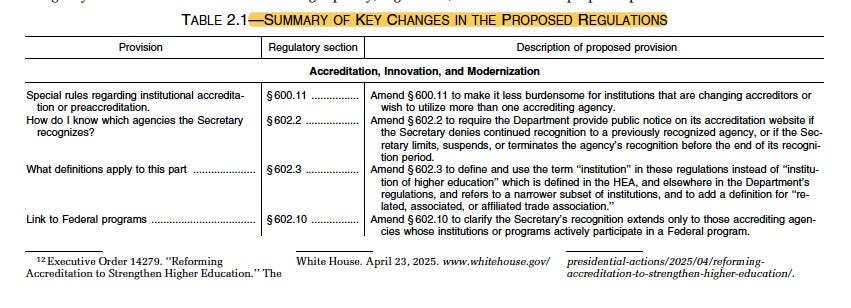
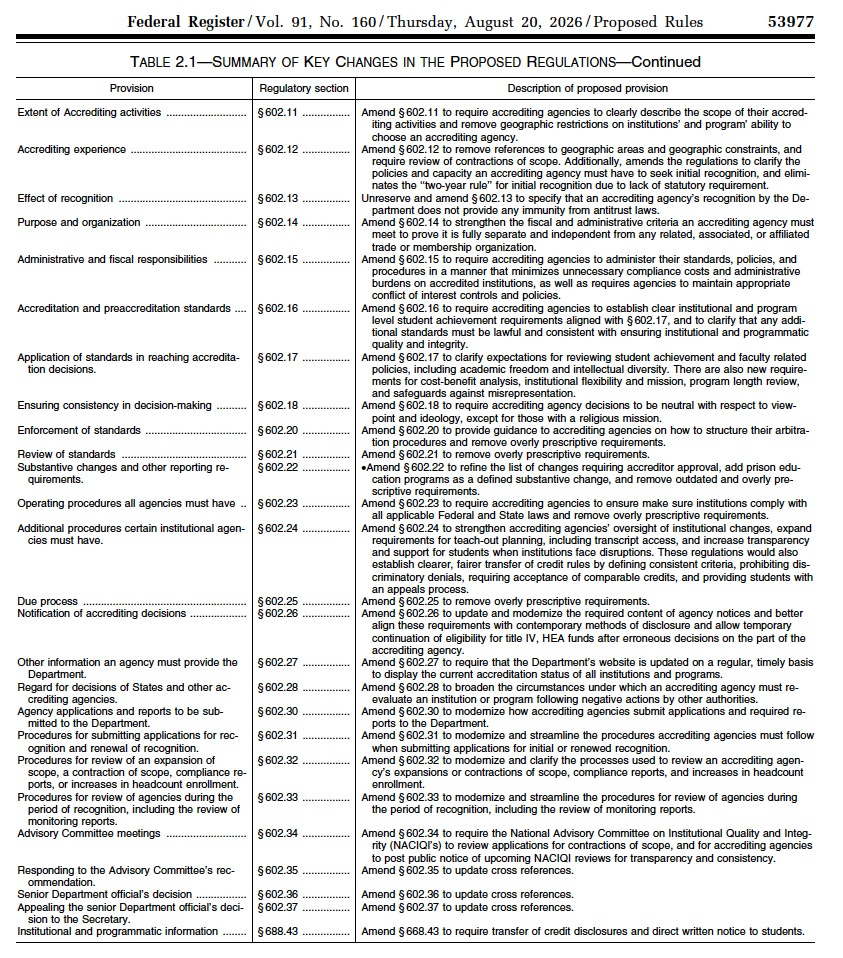
If you find a change you want to comment on, jump to the detailed description by using the ‘find’ function of your browser to jump to the specific regulatory section number. In the correct section, read the reason for the change first. This is where the ED states its justification for making changes. A comment that engages with the rationale behind the change is more difficult to dismiss.
If you can, read the proposed regulation on the last 20 pages. That’s the text that will actually govern accreditation going forward.
One note before you start writing. You can write with others and sign as a group or sign individually. These aren’t hard rules so if you have a different approach, go for it. What follows will help you build a useful comment that draws the attention of the ED readers, but other comments have their value too.
What a Comment the ED Can Use Looks Like
On page four of the PDF, the document spells out what a useful comment contains and things it shouldn’t contain, like profanity.
Comments on the specific changes listed should be arranged in the same order as they are addressed in the proposed regulations, using section numbers in your headings so it’s easy to follow along.
Be concise, but support your claims, explaining why you agree or disagree with supporting evidence, including the depth and breadth of personal or professional experience. There’s no requirement, or need, to address every single change, so focus on what is most important to you and where you can add valuable context.
If you disagree, propose alternative regulatory language. A comment that supplies text which can be adopted is categorically different from one that registers a feeling.
Make sure to include the docket number at the top ED-2025-OPE-1042.
Stick to the scope of the proposed regulations, or risk having your comment ignored.
Don’t include personal identifying information, yours or anyone else’s. They don’t need your phone number, your social security number, or anything else. Don’t give specifics about a program supervisor, the program, or even the lunch lady. If it would be a bad idea to share an identifying detail where the entire world can find it, don’t share it.
And lastly, if you are running a mass campaign with near-duplicate comments, those get collected with just one representative sample shown and a count of the rest.
The ED makes it plain, a well-supported comment is more informative than multiple form letters. Translation: your own work is better than a template repeated with different signatures.
That said, an adequate comment might look like this (FYI, don’t copy it. The person isn’t real):
Docket ID ED-2025-OPE-1042
Natta Thyreepest (Name)
Former Grad student (Why you have standing to talk)
§ 602.13 - The Department proposes to affirm that recognition does not confer immunity or any relief from Federal or State antitrust laws.
I support this change. While researching CACREP, I documented its emergence as the sole accreditor in professional counseling through the coordinated action of a coalition of counseling organizations. Those same organizations have taken further steps that restrict practice by graduates of competing programs.
I experienced this directly. The NBCC administers the examination required for the multi-state license under the Counseling Compact, and its code of ethics conditions eligibility on the candidate’s program being accredited by an agency recognized by CHEA rather than by the Department. That condition, imposed by a private body outside the Department’s recognition process, closed off compact licensure to me. Unable to build a sufficient caseload in my rural county without it, I left my degree program.
The proposed language affirms that recognition grants no antitrust immunity, but it is silent on conduct by the trade and membership organizations affiliated with a recognized agency — which is where the restraint in my case originated. I suggest adding to § 602.13:
“Recognition of an accrediting agency does not confer immunity from Federal or State antitrust law on the agency, or on any related, associated, or affiliated trade or membership organization with respect to conduct concerning the agency’s accreditation activities.”
This would close the gap between the agency the Department recognizes and the affiliated bodies that, in practice, control access to the profession.
Thank you for your consideration.
Natta Thyreepest
An even better response would comment on as many areas as appropriate for the knowledge they had, and might consider the parts of this issue addressed in other sections, but that’s why this is just a demonstration.
I’ll post my actual response separately after I’ve finished and added it to the comments.
How to Use AI Without Producing a Form Letter
AI is a powerful tool for this kind of task, because it can speed up this process from taking multiple days of work, if not well over a week, down to just a matter of hours. Or a few minutes if you really and truly are catching this at a difficult time.
Here’s how to get the most from AI while avoiding the pitfalls that give machine writing a bad name.
AI can scour an 82-page document in seconds, locate every provision touching on the topic that matters to you, with citations you can verify against the document itself.
It can explain any changes that feel buried in jargon to you, and then translate your objections back into regulation language.
AI is marvelous at drafting regulatory language that you can then edit, and it can tighten up your rambling 3000-word comment into a sharp 700-word piece.
Best of all, AI can check your comment against the ED’s requirements, making sure it follows the structure and that everything is in scope.
Where AI Can Cause Problems and Benefits From Human Oversight
AI still hallucinates. Every citation, quotation, or specific detail must be verified against original documentation, either these regulations or your supporting research.
That’s why you cannot let it supply facts. Evidence you have in support or protest must be yours, be it your experience, your institution, or your data. And if you use an AI-generated anecdote, that is a fabrication written into federal records.
Another downside to AI writing is that it works to the median. This is what gives AI prose that formulaic feel, and runs the risk of your comment sounding like it is part of a mass campaign. Maybe you don’t mind that, but if you do, write your own first draft, then use AI to sharpen it up.
Your comment is published in full, permanently, under your name. So it pays to make sure your words represent your intentions. AI is now a fact of life, and it is not wrong to use it, especially when time is at a premium, but it is also on you to monitor and approve of its resulting language.
The one thing that AI can’t do is tell you what matters to you, or whether any one of these provisions has unintended consequences predictable with the right knowledge, which is what this comment period is asking for. Human judgment adapts these rules. Only humans can really say what we think and know about that.
Submitting
Comments can only be submitted through the portal at regulations.gov, no fax, no email, and nothing after the period closes on 21 Sept.
The docket ID ED-2025-OPE-1042 should be at the top of the comment. Submit once; duplicates only confuse the record.
If your comment is especially long, attach it as a document and summarize it in the box.
If you have trouble submitting through the portal or need help, you can contact regulationshelpdesk@gsa.gov or call 1-866-498-2945.
The deadline is 21 Sept 2026. Jeopardy music should be ringing in your ears. FYI, filing early is perfectly ok.
Whether you choose to comment or not, these new regulations will be finalized, and life will move on into a new world shaped by these changes. This record is the only place to give voice to a specific objection and offer proposed text to improve the situation. It’s also the only place to counter potential criticism and take a stand. The choice is yours.
For additional info, check out this highly informative webinar from the National Association of Scholars with two members of the National Advisory Committee on Institutional Quality and Integrity NACIQI, Adam Kissel and Bob Eitel.
I’m hugely honored to have gotten a shout-out in this meeting.
Help Keep This Conversation Going!
Share this post on social media. It costs nothing but helps a lot.
Become a subscriber. Higher subscriber numbers would draw in guest writers and interesting folks for interviews.
Want more perks? Become a Paid Subscriber to get chatroom access and let’s talk about what else Diogenes In Exile can do.
Support from readers like you keeps this project alive!
Diogenes in Exile is reader-supported. If you find value in this work, please consider becoming a pledging/paid subscriber, donating to my GiveSendgo, or buying Thought Criminal merch. I’m putting everything on the line to bring this to you because I think it is just that important, but if you can, I need your help to keep this mission alive.
Already a Premium subscriber? Share your thoughts in the chat room.
About
Diogenes in Exile began after I returned to grad school to pursue a master’s degree in Clinical Mental Health Counseling at the University of Tennessee. What I found instead was a program saturated in Critical Theories ideology—where my Buddhist practice was treated as invalidating and where dissent from the prevailing orthodoxy was met with hostility. After witnessing how this ideology undermined both ethics and the foundations of good clinical practice, I made the difficult decision to walk away.
Since then, I’ve dedicated myself to exposing the ideological capture of psychology, higher education, and related institutions. My investigative writing has appeared in The Federalist, Real Clear Education, Heterodox STEM, Minding the Campus, The College Fix, and has been republished by the American Council of Trustees and Alumni. I also speak and consult on policy reform to help rebuild public trust in once-respected professions.
Occasionally, I’m accused of being funny.
When I’m not writing or digging into documents, you’ll find me in the garden, making art, or walking my dog.