



Diogenes In Exile is reader-supported. Keep the lamp of truth burning by becoming a paying subscriber—or toss a few drachmas in the jar with a one-time or recurring donation. Cynics may live in barrels, but websites aren’t free!
Editorial Note: This essay is the third of three in which I uncover the failings of contemporary social work education. All three are dedicated to my brother–and to all who refuse to let their group identity speak for them. Part 1, Part 2.
Two months after graduating from an intellectually hollowed-out social work program in May 2025, I stumbled upon sociologist Frank Furedi’s book, Why Borders Matter: Why Humanity Must Relearn the Art of Drawing Boundaries. While the whole book is well worth a read, Chapters 2 & 3 offer a window into what has gone so badly awry both within my program and across contemporary social work education.
Traditionally, as mental health practitioners, social workers are charged with upholding realistic, professional boundaries to keep client-worker roles in place and prevent lapses in ethics. Indeed, the word “boundary” is mentioned 12 times in the profession’s Code of Ethics; however, beneath the surface of training happening in the classroom, two developments have turned U.S. social work education’s relationship with “boundaries” upside-down.
Reordering #1
The first development sounds nice in theory. Under new guidelines in the discipline’s 2022 Education Policy and Practice Standards (EPAS), social work educators have received a green light to dissolve the importance of boundaries in the name of social “allness” and what is collectively known as ADEI, i.e. Anti-racism (all “races” are accepted), Anti-oppression (all power differences are equalized), Diversity (all social differences are accepted), Equity (all outcome disparities are equalized), and Inclusion (all individuals are accepted).
Furedi’s insight is helpful here. He points out a broader social expectation that has developed in the West starting in the 1960s, one that he calls “radical openness”. Decade after decade, this expectation has increasingly rendered social boundaries frivolous and untrustworthy, as he describes:
“Openness has become the medium through which the contemporary sensibility of boundarylessness has come to influence people’s imagination. In recent years, it has become radicalised to the point where the very act of closing evokes suspicion.”
The Council on Social Work Education (CSWE), social work’s national accrediting body and producer of the 2022 Educational Policy and Accreditation Standards (EPAS), imparts this radical openness from the top down across its 900+ educational programs, most frankly stated in its 2024-2025 Annual Report: “Social work is for everyone. No exceptions.” The same goes for the CSWE’s promotion of social differences–or diversity–that social workers must be open to, regardless of limits, constraints, or consequences (though note the already over-abstracted concept political ideology, not political beliefs or political values):
“The presence of differences that may include age, caste, class, color, culture, disability and ability, ethnicity, gender, gender identity and expression, generational status, immigration status, legal status, marital status, political ideology, race, nationality, religion and spirituality, sex, sexual orientation, and tribal sovereign status.”
A seductive-sounding corollary to this first development–i.e., social work’s advocacy for radical openness–is what Furedi calls “non-judgmentalism,” or an absolute refusal to draw boundaries around social differences in the name of inclusion and compassion. For example, within the CSWE’s Interpretation Guide, a document that programs use to understand and apply the 2022 EPAS, the value of “inclusion” becomes completely non-judgmental, only “achieved when all people are welcomed to fully participate.”
Social work education’s broader “professional” attitude has also come to reflect the current non-judgmental ethos of university life. Furedi puts his finger on a general disposition where
“In higher education, ambivalence, hybridity, fluidity, and transgression are favourably contrasted to boundedness….This sentiment, conveyed through the lauding of ‘non-judgementalism,’ has a commanding influence on regard for the symbolic boundaries that frame everyday life. In contemporary culture, judgemental behaviour is defined in entirely negative terms.”
He continues, briefly explaining the current mood:
“As far back as 1948, the liberal literary critic, Lionel Trilling, wrote of a ‘characteristically’ American impulse not to judge people too harshly, noting the assumption that the consequences of judgement ‘will turn out to be “undemocratic”’. In the present context, where there is a widespread reluctance to draw moral boundaries, a non-judgemental orientation towards life has become the defining feature of the prevailing cultural sensibility.”
Reordering #2
Here, it turns out, is the second, contradictory development: social work seems to refrain from drawing moral boundaries due to its radical openness and non-judgement, but in fact has hardened boundaries around what it deems as its “core ideology”. To a new student, this looks like professors who talk about being as inclusive and understanding as possible, but in actuality draw a tightly conscripted set of boundaries based in coercive egalitarianism, radical democracy, critical social justice, utopian politics, and radical social engineering.
This twist constitutes a fifth bait-and-switch, on top of the four I identified last week that educators use to keep students hooked and philosophically captured:
Bait #5: Justify the superiority of social work with the language of unconditional “openness” and “non-judgment”.
Switch #5: Close off any pretense of competing views to students and escalate judgment of dissenters into the moral realm. Monopolize the acceptable use of openness and professional judgment through “progressive” premises.
This bait-and-switch has entrenched five educational–soon-to-be professional–hypocrisies, effectively “leaving [students] unprepared to respond to the complexities of practice and failing thousands of clients across the country in the process,” as I argued last year:
Undiverse “Diversity”: Social diversity is what counts; intellectual and political diversity–including the need for evidence and humility–does not.
Exclusive “Inclusion”: Inclusion is extended to “all people,” except those who question the reality, possibility, or value of inclusion itself.
Inequitable “Equity”: Equity in resources and status is what counts; equity in values, political opinions, and arguments around social change (including starting premises, means, rates of change, and final ends) do not.
Racist “Anti-Racism”: Anti-racism is extended to all races, except “White” people.
Oppressive “Anti-Oppression”: Anti-oppression–i.e. radical equality–for social groups is what counts; anti-oppression for individual ideas, values, choices, freedoms, and visions of the Good Life does not.
Holding onto Intellectual Pluralism
I almost became hooked myself in my Master’s of Social Work (MSW) program at Colorado State University (CSU), mistakenly trusting that professors would allow students to honestly grapple with ideas and come to their own conclusions. (My colleague Arnoldo Cantú, drawing on a book by linguist Amanda Montell, calls this sheer lack of intellectual honesty “cultish.”).
My saving grace came from cross-checking my education with people close to me over the three years, plus the set of theoretically diverse International Studies classes I took during undergrad, which included a fascinating and rigorous Ethical Foundations of Global Economic Policy class (approximate syllabi here).
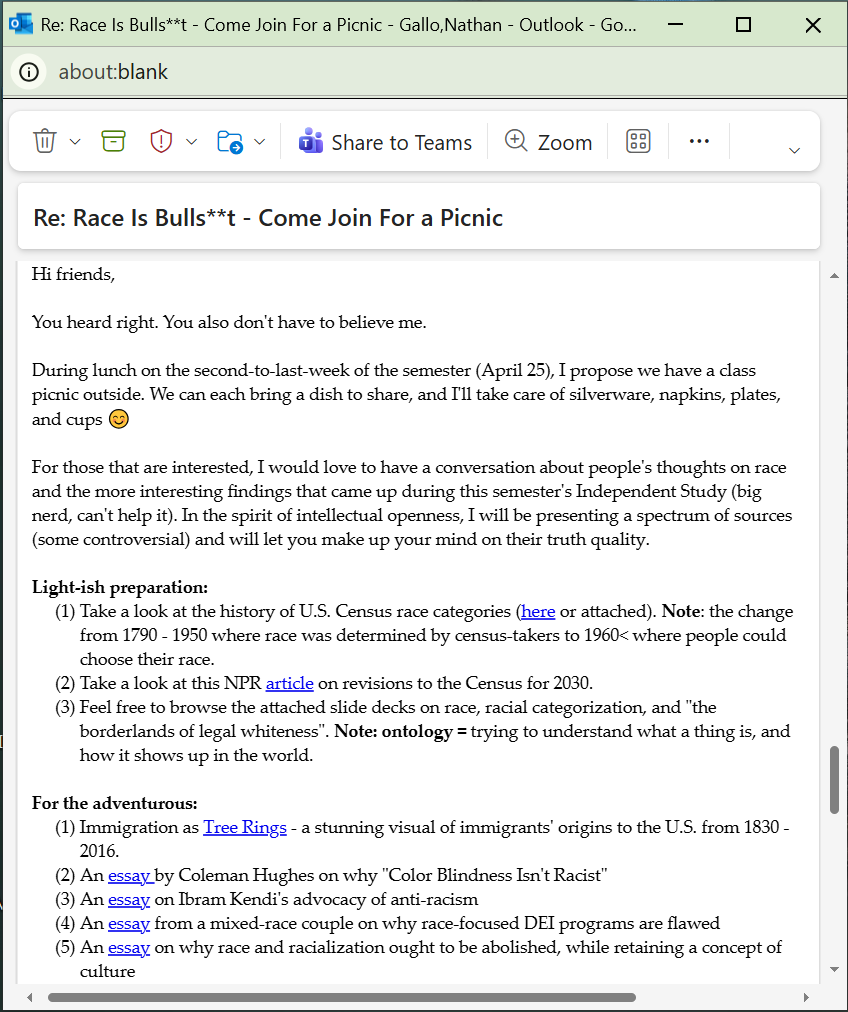
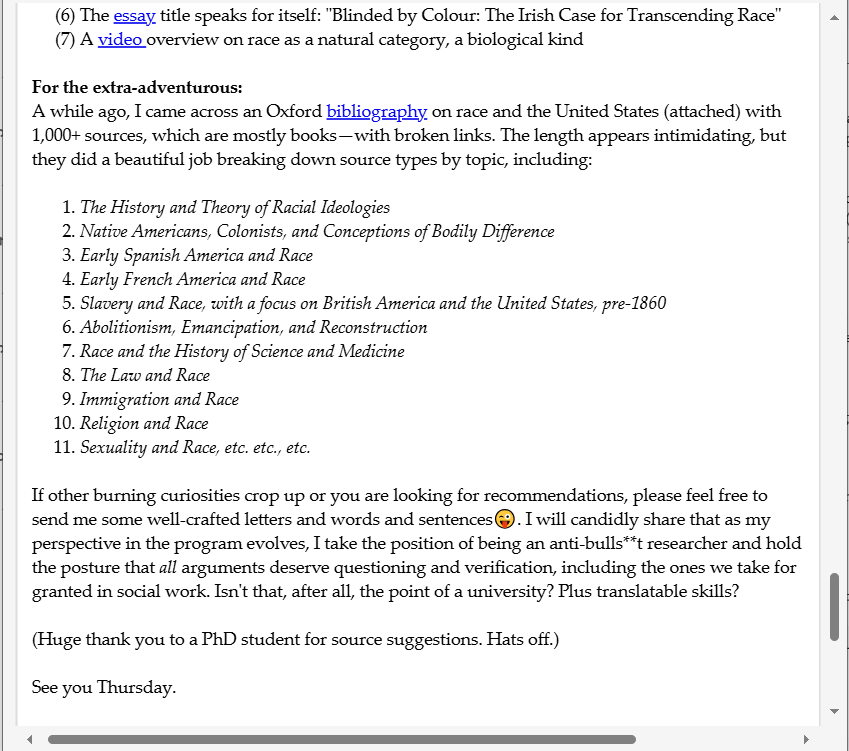
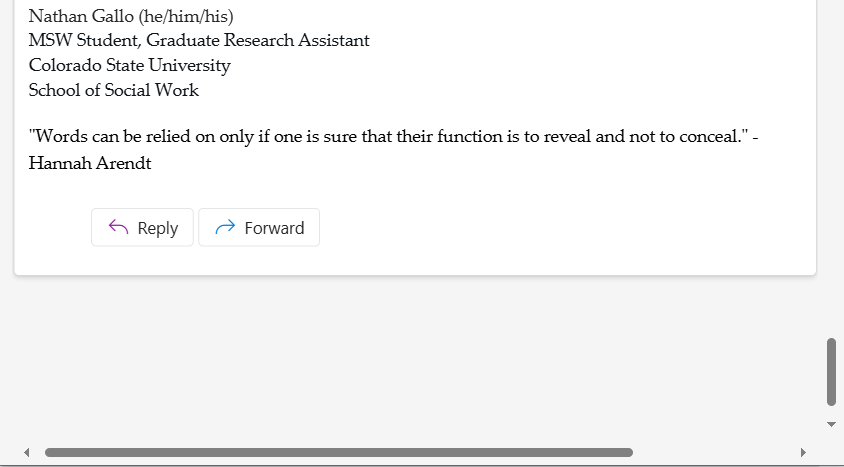
By Spring 2024, I looked for some way to step outside of the program’s psychologically closed bubble and pursued an independent study on the U.S. census and race. In April, while contending with the degree to which social work conveyed a deceptive, false pretense of “openness,” I sent the following email to my MSW cohort. (Email addresses are removed to preserve confidentiality. The email title was intentionally provocative to pique interest, harkening back to Harry Frankfurt’s book On Bullshit. As I explained, “In the spirit of intellectual openness, I will be presenting a spectrum of sources (some controversial) and will let you make up your mind on their truth quality.”).
Even so, there was a limit to the degree of sincere intellectual pluralism and realism that one could petition for in the program, knowing that professors stuck to their nationally-backed “progressive” scripts without presenting counter-arguments. In fact, CSU includes “transparency, openness, and inclusivity” as part of its core values–despite the fact that one faculty member’s racialized, shame-inducing teaching methods are anything but.
There is more to the story. However, for now, after having my own openness questioned by a School of Social Work employee in October last year, reading Why Borders Matter has been undeniably clarifying and shed light on the fundamental importance of boundaries grounded in professional humanism, rather than deceptive emotional appeals and vague words.
Moreover, in the process of writing this essay series, I’ve come to realize that educational boundaries associated with reason, rigor, and excellence will continue to eternally be worth defending, even if 2020s social work education–in the name of “openness”–refuses to believe in all three.
Nathan Gallo, MSW, CNA, is a recent Master of Social Work graduate and hospital nursing assistant based in northern Colorado. He has written about the importance of cognitive liberty, tolerance, and value pluralism in social work education. Gallo also led a case study article on medical aid in dying (MAID) and motor neuron disease, published in the flagship journal for this practice, the Journal of Aid-in-Dying Medicine.
Further Reading
Help Keep This Conversation Going!
Share this post on social media. It costs nothing but helps a lot.
Become a subscriber. Higher subscriber numbers would draw in guest writers and interesting folks for interviews.
Want more perks? Become a Paid Subscriber to get chatroom access and let’s talk about what else Diogenes In Exile can do.
Support from readers like you keeps this project alive!
Diogenes in Exile is reader-supported. If you find value in this work, please consider becoming a pledging/paid subscriber, donating to my GiveSendgo, or buying Thought Criminal merch. I’m putting everything on the line to bring this to you because I think it is just that important, but if you can, I need your help to keep this mission alive.
Already a Premium subscriber? Share your thoughts in the chat room.
About
Diogenes in Exile began after I returned to grad school to pursue a master’s degree in Clinical Mental Health Counseling at the University of Tennessee. What I found instead was a program saturated in Critical Theories ideology—where my Buddhist practice was treated as invalidating and where dissent from the prevailing orthodoxy was met with hostility. After witnessing how this ideology undermined both ethics and the foundations of good clinical practice, I made the difficult decision to walk away.
Since then, I’ve dedicated myself to exposing the ideological capture of psychology, higher education, and related institutions. My investigative writing has appeared in Real Clear Education, Minding the Campus, The College Fix, and has been republished by the American Council of Trustees and Alumni. I also speak and consult on policy reform to help rebuild public trust in once-respected professions.
Occasionally, I’m accused of being funny.
When I’m not writing or digging into documents, you’ll find me in the garden, making art, walking my dog,

I received my MSW in clinical social work in 1991 from New York University. We studied theories of psychological development, specific skills in working with individuals, families and groups, we took one social policy class and one class on "ethnocultural issues." We did a research project. 3 days a week we went to a field placement. We took electives on psychoanalytic theories. This prepared me for a career as a psychotherapist. I don't know who is going to be a psychotherapist in the future because from everything I've been hearing, including your blog, MSW and counseling students are learning zero about how to do their future jobs. It's true that not all MSWs become psychotherapists but if you don't learn about human psychological development you cannot function competently doing any kind of social work.